About Me
I am a Ph.D. student at the School of Statistics, Renmin University of China, advised by Professor Hanfang Yang. My research focuses on training data resources synthesis and evaluation for large language models, as well as large language model reasoning.
I received my bachelor’s degree from Nanjing University and pursued both my master’s and Ph.D. studies at Renmin University of China. I am currently a research intern at Microsoft Research Asia, working with Zhenghao Lin, Xiao Liu, and Yeyun Gong.
Publications
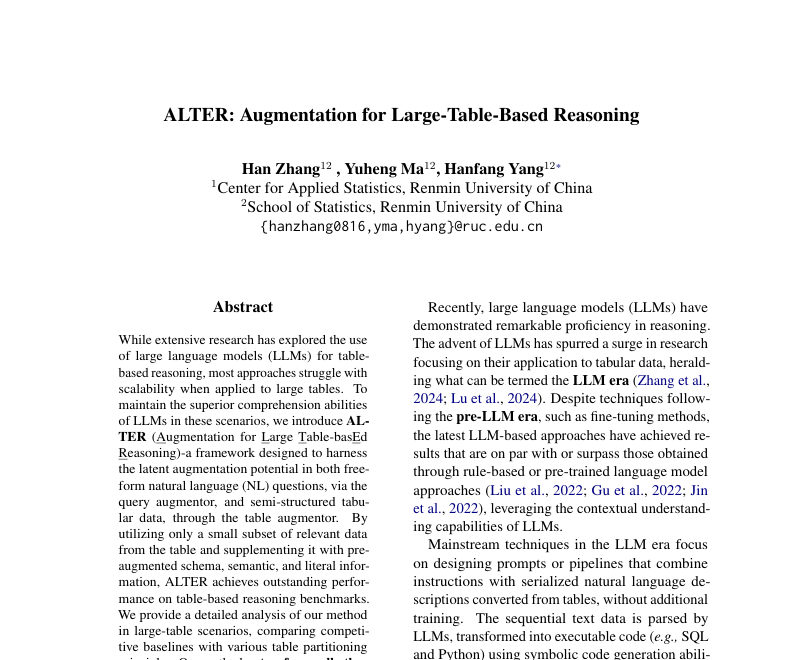
ALTER: Augmentation for Large-Table-Based Reasoning
Introduces an augmentation framework for large-table reasoning that helps language models work with tables beyond their context window.
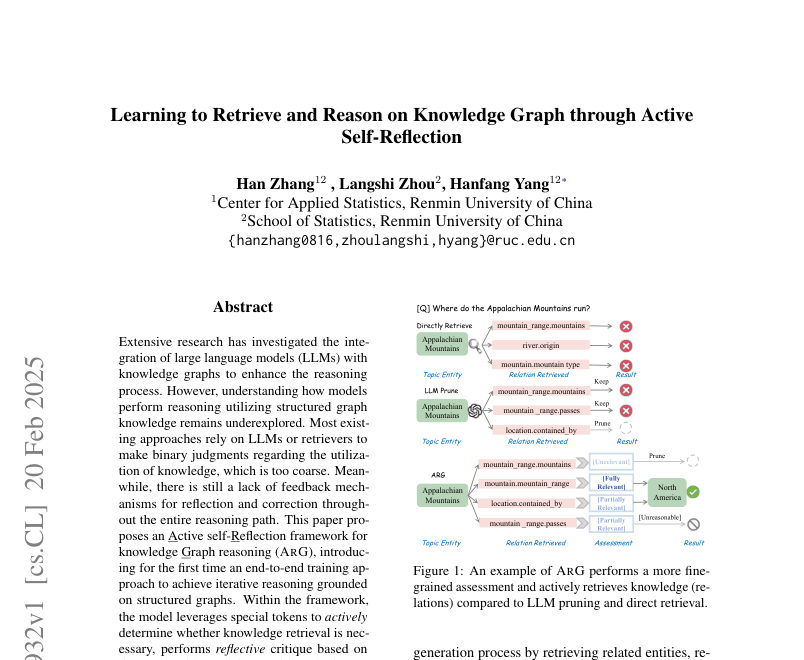
Learning to Retrieve and Reason on Knowledge Graph through Active Self-Reflection
Presents ARG, an end-to-end framework that actively retrieves graph knowledge, reflects on evidence, and iteratively reasons along interpretable paths.
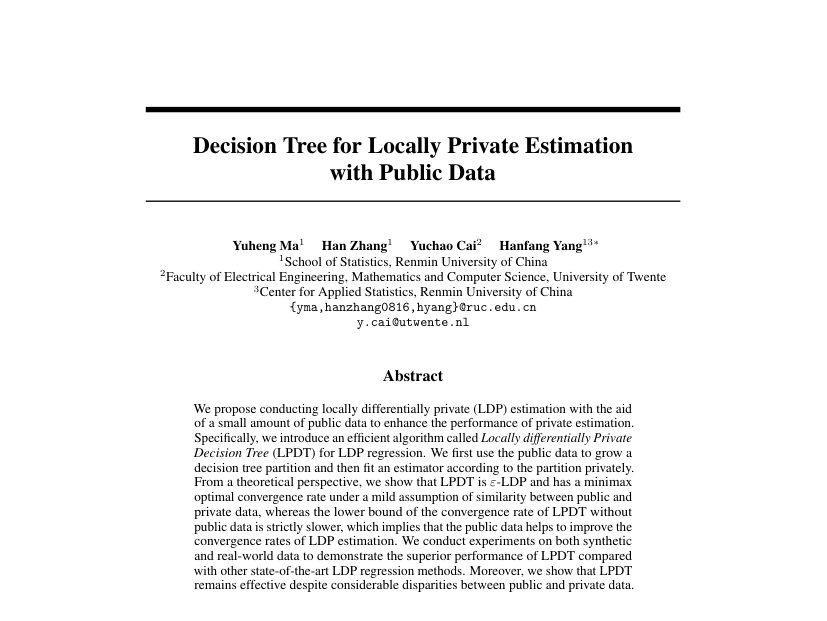
Decision Tree for Locally Private Estimation with Public Data
Studies locally private estimation with public data and develops a decision-tree method for adapting estimators to the available public information.
Education
Nanjing University Bachelor's
Department of Mathematics · Statistics
Selected coursework: Mathematical Analysis (90), Advanced Algebra (97), Analytic Geometry (96), Ordinary Differential Equations (95), Foundations of Probability (100), C++ Programming, Real Analysis, Partial Differential Equations, Advanced Mathematical Statistics (98), Applied Stochastic Processes (97), Discrete Mathematics (96), Database Systems, Computer Networks, Data Analysis, Data Structures and Algorithm Design, Introduction to Data Mining, and Modern Information Technology.
Renmin University of China Consecutive M.S.–Ph.D. Track
School of Statistics / Institute for Interdisciplinary Sciences
Program: M.S. in Statistics (Sep. 2022 – Jun. 2025); Ph.D. in Statistics (Sep. 2025 – Present).
Research: natural language processing, structured-data reasoning and applications, and large language model pre-training and fine-tuning.
Honors & Awards
- First-Class Academic Scholarship, Renmin University of China
- National Scholarship
- Selected for Nanjing University's Top-Notch Basic Disciplines Program and awarded its scholarship
- Hong Kong Nanjing Association Scholarship; Star Student in Mathematical Sciences, Department of Mathematics, Nanjing University
Experience
Microsoft Research Asia 
Research Intern · Beijing, China
AgiBot 
Algorithm Intern
Built the embodied-intelligence ChatAssistant capability from the ground up.
- Data: contributed to a tool-use dataset for embodied robot instructions.
- Algorithms and product: implemented Agent Chat, voice interaction, internal knowledge retrieval, and tool use, then integrated the dialogue service into downstream product lines.
- On-device deployment: evaluated deployment and quantization approaches on NVIDIA Orin, including llama.cpp, AutoAWQ, and GPTQ.
SQLBOY Startup Incubation Project
Algorithm Engineer
Contributed across the full lifecycle of an RUC startup-incubator project, from LLM research and fine-tuning to backend deployment and frontend development, establishing the complete pipeline from model adaptation to downstream application deployment.
- Implemented instruction fine-tuning and model deployment.
- Built a task-specific Agent framework with LangChain and vector retrieval.
- Developed the backend with FastAPI and the frontend with Vue 3 and TypeScript.
Samsung Research China Beijing (SRCB) 
Algorithm Intern · Language Intelligence Team (LIT)
Competed in the CVPR 2022 Workshop Action Learning From Realistic Environments and Directives (ALFRED) Challenge, placing third on the leaderboard.
- Task decomposition: generated key steps from language instructions and scene knowledge, decomposing tasks in a Seq2Seq manner to support household-robot learning and preview expected actions.
- Semantic mapping: constructed semantic maps from RGB-D observations and instance-segmentation labels for room navigation and object manipulation.
- Algorithm optimization: improved pose adjustment, action refinement, and other scenario-specific behaviors.